
 De
De
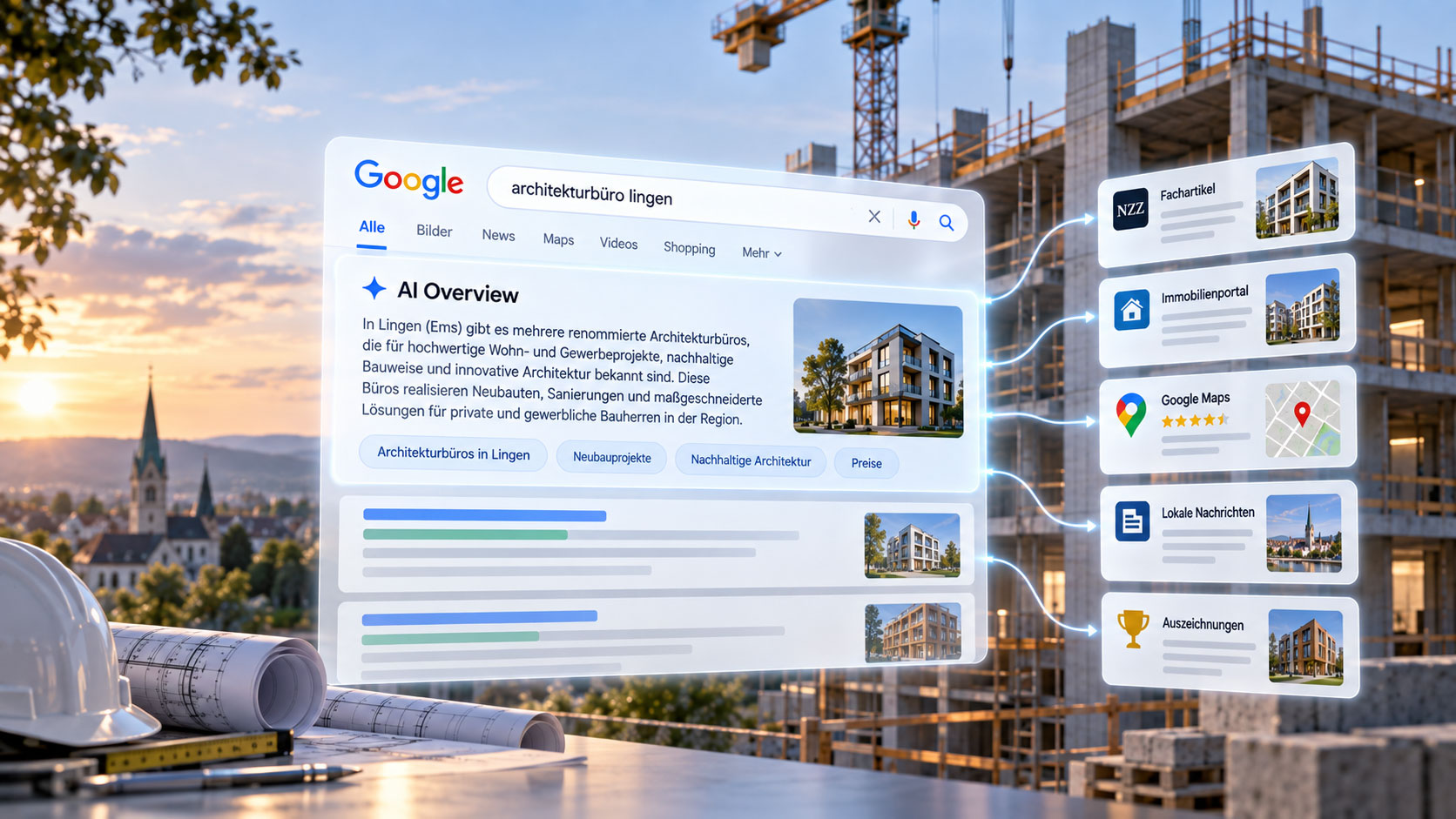
An architecture firm can have a good website, strong projects and a well-known name and still receive less organic attention. The reason does not necessarily lie in the quality of its online presence. Potential clients and investors search differently today. AI Overviews and AI search systems already answer specific questions directly on the search results page. This creates zero-click search: the information is visible, but the click through to the website does not happen.
For architecture marketing, this changes the starting point. A good ranking alone is no longer enough. Your firm must also be recognized as a relevant entity. In addition to your own website, industry sources, project platforms, awards, local business data and consistent mentions are becoming increasingly important. Firms that build these signals strategically can strengthen their visibility even where the traditional search results list is no longer the main focus.
AI Overviews and the Zero-Click Shift
An AI Overview is an AI-generated summary created by Google that answers a search query directly on the search results page. An AI search engine, or answer engine, on the other hand, processes information from multiple sources and uses it to formulate a direct answer to a specific user question.
This changes search behavior. An analysis by the Pew Research Center of 68,879 Google searches from March 2025 showed that an AI Overview appeared in 18 percent of the search queries examined. For queries containing at least ten words, the share was as high as 53 percent.
When the Answer Appears Before the Click
Longer search queries are particularly interesting for architecture firms. A user does not always search simply for “architect Munich.” They may ask for a firm specializing in sustainable residential buildings in Munich or an architecture firm with experience in renovating listed buildings. An architecture firm’s website should therefore make it immediately clear which services and specializations the firm offers.
Such specific questions give AI systems more information to work with. For your content, this means that individual keywords should no longer be the sole focus. It is much more important to answer specific questions clearly and use real projects to demonstrate where your firm’s experience lies. Three changes are particularly relevant:
Direct answers:
Users receive essential information directly in search results. An additional click is therefore not always necessary.
Multiple sources:
AI systems can combine information from different websites and sources. This makes a firm’s entire digital presence more important.
New selection criteria:
AI systems can categorize multiple firms based on specialization, projects and location. For architecture firms, it is therefore increasingly important that these characteristics are clearly and consistently identifiable online.
This does not mean that your website is becoming less important. It remains your most important owned source for services, projects and company information. But its role is changing. It should no longer simply attract visitors through Google. It must provide information clearly enough for search systems to understand it, categorize it and connect it with your firm.
Google itself continues to expand AI-powered search. In May 2026, Google stated that AI Overviews reach more than 2.5 billion monthly active users. At the same time, AI Mode surpassed one billion monthly active users.
Why Traditional SEO Alone Is No Longer Enough
Traditional SEO remains important. However, a good ranking is no longer enough to guarantee visibility. A page can rank highly for “architect Munich” and still receive fewer visitors if AI provides the relevant answer before the organic search results. At the same time, the image of a firm is increasingly formed from multiple sources. Industry articles, project pages, awards and company profiles can collectively show what a firm stands for and what experience it brings.
For your architecture marketing, this shifts the focus. The same applies to real estate marketing, where clients, project developers and investors compare different firms. Links and rankings continue to play a role. But it is equally important whether your firm is clearly associated online with specific services, projects and regions. This is where AI SEO comes into play. It is not only about being found, but also about appearing as a relevant source in the answers generated by AI systems.
The New Currency: Brand Citations and Entity Authority
A brand citation is a mention of a company in an external source. It may include a link, but it does not have to. What matters is the context. The name, location, services and projects should be clearly associated with your firm.
A mention in an industry publication, for example, can contribute more strongly to how your firm is categorized than a random directory listing. The same applies to an award, a project feature on an architecture platform or an editorial article about a completed building. Such sources create additional context around your entity.
What Search Systems Should Recognize About Your Firm
Your website is the starting point you can control. However, the digital image of your firm is created from many individual pieces of information. Key details should therefore be as consistent as possible across different platforms. Three areas are particularly important:
| Signal | Example | What It Communicates | What to Watch For |
|---|---|---|---|
| Brand Citation | Industry article | External mention | Choose a reputable source |
| Project Reference | Award | Expertise | Clearly attribute the project |
| Local SEO | Google Business Profile | Regional context | Keep data up to date |
| Entity Data | Organization Schema | Company identity | Keep information consistent |
Unlinked mentions can also play a role. They help search systems understand a name not merely as a URL, but as a specific organization. The goal is a consistent digital profile. The Knowledge Graph should also be taken into account. In simplified terms, it represents structured connections between entities, places, organizations and other information. The more clearly these relationships are represented, the easier it is to categorize a company digitally.
Where Do Clients and Investors Research Today?
The initial research process no longer necessarily begins with a traditional Google search. A prospective client may ask a question in ChatGPT or Perplexity, then look at a project on Houzz and afterwards check the firm’s Google Business Profile. An investor may additionally compare industry articles, awards and specific references.
From Google to Houzz: Where Your Reputation Is Built
This development makes a broader presence necessary. That does not mean maintaining every possible profile. What matters are the sources that are relevant to your industry and target audience. These include, above all:
- AI assistants: ChatGPT and Perplexity can help users with their initial research. It is therefore relevant which sources are used to generate answers.
- Architecture platforms: Houzz and Baunetz provide additional context for projects, services and specializations. Clear project information is particularly valuable here.
- Google Business Profile: A well-maintained profile connects your firm with a specific location. This is particularly important for Local SEO.
- Industry press: Editorial articles can independently confirm expertise and specialization beyond your own website.
- Awards: Awards connect your firm with specific projects and provide an additional external quality signal.
Quantity alone is not what matters. A relevant mention in a recognized industry source can be more valuable than numerous listings without a clear thematic connection. For architecture marketing, this creates an omnichannel approach. Your website, industry portals, local business data and external references should not exist in isolation. Together, they should communicate the same image of your firm.
Which Steps Matter Most Now?
The new search landscape does not automatically require a complete website relaunch. Often, the greater potential lies in details that have received little attention so far. What matters is structuring existing information effectively and strengthening the right external signals. Seven measures can help you strategically improve the visibility of your architecture firm:
- Review your entity: Check your name, address, phone number, website and specializations on important platforms. Any discrepancies should be corrected.
- Add structured data: Use appropriate markup such as Organization or LocalBusiness schema. This makes key company information machine-readable.
- Expand project pages: Do not only describe the finished building. Include the location, project type, design task, services, special features and your specific role.
- Develop AEO content: Answer Engine Optimization focuses content on specific questions. For example, explain what experience your firm has with renovations, residential construction or sustainable architecture.
- Build citations: Identify relevant industry publications, architecture platforms, awards and industry sources. The goal is to gain credible mentions with a clear project or company connection.
- Maintain Local SEO: Keep your Google Business Profile up to date. Location, category, contact details, images and other information should match your website.
- Test AI visibility: Ask typical client questions in different AI systems. Check which firms are mentioned, which sources appear and how your own firm is described.
The final point provides an important shift in perspective. You are no longer measuring only whether your website ranks. You are checking whether your firm appears at all as an answer to a specific question.
What Does This Mean for AEO and LLM SEO?
Answer Engine Optimization focuses on structuring content so that answer systems can understand and cite it. A good answer should be stated as clearly as possible within the text. Headings, short definitions, lists and specific examples help both readers and search systems.
LLM SEO goes one step further. Here, the central question is how a Large Language Model recognizes and categorizes a company based on information from different sources. For an architecture firm, this means, for example, that its name, location, projects and specialization should not appear only on its own website.
Conclusion: From Rankings to Citations and Omnichannel Authority
Zero-click search does not mean the end of SEO. Rather, it changes how visibility is created. Rankings remain important, but they are now only one part of the overall picture. For architecture firms, the focus is therefore shifting from individual search positions toward citations, entity authority and omnichannel presence. Your firm should not only be presented convincingly on its own website. It should also be clearly recognizable across relevant industry sources, project platforms, local profiles and awards.
This is where traditional SEO, AI SEO, AEO, GEO and LLM SEO come together. The best digital presence is one that is understandable to people and unambiguous to search systems.
If you would like to know how well your architecture firm is already prepared for this development, an AI readiness and visibility check can be useful. Linvelo can identify where your firm already has a strong presence, which entity signals are missing and where an investment in visibility could be particularly worthwhile.
FAQ: What Should Architecture Firms Know Now?
What Is the Most Important Difference Compared with Traditional SEO?
Traditional SEO focuses heavily on rankings and organic clicks. With AI-mediated answers, it also becomes important whether your firm is recognized as a credible source and a clearly defined entity.
What Is AEO?
AEO stands for Answer Engine Optimization. Content is structured so that answer systems can identify and answer specific questions as clearly as possible.
Do I Need a New Website for This?
Not necessarily. Existing project pages, company information and structured data can often be improved strategically. The first step is to assess the current situation.
What This Means for Architecture Firms in the DACH Region
For architecture firms in the DACH region, regional experience, relevant references and consistent company data are important. Location, specialization and projects should be consistent across the website, Google Business Profile and industry platforms. BDA membership, awards, industry articles and a complete legal notice also strengthen trust and Local SEO.